
History
Meet the Inventor of the Piano
5 min read
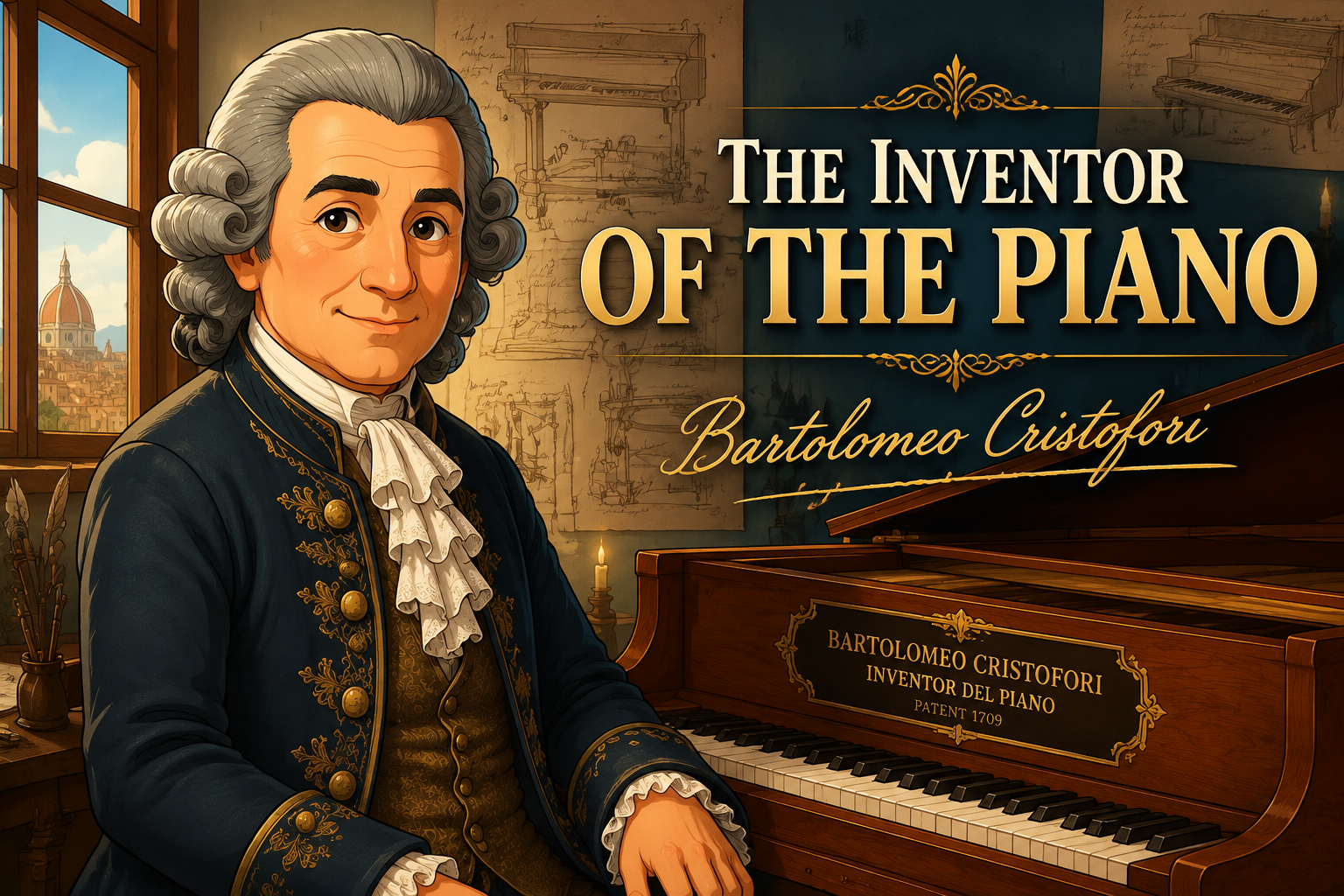
More than 300 years ago, in Italy, a skilled instrument maker named Bartolomeo Cristofori began working on an idea that would transform the history of music. Living in the world of royal courts and aristocratic patrons, Cristofori built keyboard instruments for wealthy and influential families who valued music and innovation.
At that time, one of the most popular keyboard instruments was the harpsichord. However, the harpsichord had a limitation: the player could not control the volume of each note by playing harder or softer. Every key produced almost the same level of sound.
Cristofori imagined a different kind of instrument — one that could respond to the musician’s touch. His invention used a new hammer mechanism that allowed the strings to be struck with different levels of force. This simple but revolutionary idea gave performers the ability to create contrast, expression, and emotion through their playing.
He called his invention the **“gravicembalo col piano e forte,”** which means **“harpsichord with soft and loud.”** This name described the instrument’s greatest innovation: the ability to play both quiet and powerful sounds.
Cristofori’s mechanism was remarkably advanced for its time. Although the new instrument did not immediately become popular, his design introduced the foundation of the modern piano action. Over the following centuries, builders improved and expanded his ideas, creating the instrument we know today.
Every time a pianist plays a soft melody, a powerful chord, or a sudden musical change, they are using a principle that began with Cristofori’s invention.
His creation changed the relationship between musician and instrument. The piano became not only a machine that produces sounds, but a responsive partner capable of expressing the full range of human emotion.